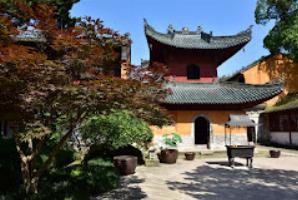
Guoqing Temple

Your Page Title

User Profile
The initial site for the creation of the Tiantai school of Mahayana Buddhism founded by Zhiyi (538–597 AD). Covers an area of some 23000 m2 (250000 sq ft) and features 600 rooms in a total of 14 different halls
The Guoqing Temple (simplified Chinese: 国清寺; traditional Chinese: 國清寺; pinyin: Guóqīng sì; Wade–Giles: Kuo-ch'ing Ssu) is a Buddhist temple on Mount Tiantai, in Taizhou, Zhejiang Province, China. Originally built in 598 CE during the Sui dynasty, and renovated during the reign of the Qing Yongzheng Emperor (r. 1722–1735), the temple is located roughly 220 kilometres (140 mi) from the city of Hangzhou. It was the initial site for the creation of the Tiantai school of Mahāyāna Buddhism, founded by the Chinese Buddhist teacher Zhiyi (538–597 CE).[1] The temple covers an area of some 23,000 m2 (250,000 sq ft) and features 600 rooms in a total of 14 different halls, including the Grand Hall of Sakyamuni, the Hall of Five Hundred Arhats and the Hall of Monk Jigong. The exterior of the building features Chinese pagodas such as the Sui Pagoda, the Seven Buddha Pagoda, and the Memorial Pagoda of Monk Yi Xing (6832–727 CE).[2][3]
This user account status is Approved

Views: 89869

Footer

© 2023 OPEN SANGHA FOUNDATION. All Rights Reserved


Logout