
Category: Sudents and questions

Anyone can make a statement or ask about practice

  • “Shifting Perspectives: Nurturing Wholesome Thoughts in the Cycle of Mindfulness”

    “Shifting Perspectives: Nurturing Wholesome Thoughts in the Cycle of Mindfulness”

    Thomas Hammon

    list-xl@1x.webp

    “Shifting Perspectives: Nurturing Wholesome Thoughts in the Cycle of Mindfulness”

    In our fast-paced world, we often seek closure and finality in various aspects of life. This pursuit is mirrored in the invention of the clock, a symbol of humanity’s quest for order and progression. However, it’s intriguing to consider that the invention of the clock might be the harbinger of both order and chaos. While the atomic bomb’s invention is widely regarded as a monumental turning point, the invention of the clock might bear even more significant consequences, reshaping our understanding of time and thought.

    The clock instills a notion of linear progression. A relentless march forward where our thoughts and actions must fit within the confines of this structured timeline. This concept is both a boon and a bane. On one hand, it propels us to accomplish goals and meet deadlines. Yet, it also creates the illusion that once our thoughts are redirected from unwholesome to wholesome, the clock’s hands move forward, and we’re on an uninterrupted journey into the future. In truth, life operates in cycles, and this realization unveils a deeper perspective on mindfulness.

    Cycles govern our existence in ways we often overlook. Just as we can fall back into old habits if we don’t actively cultivate change, we can lose skills we once mastered if we cease practicing. This applies not only to physical skills but also to the art of nurturing wholesome thoughts. A key point emerges: consistent practice is the bedrock of sustainable change. Arthur Rubinstein’s recognition that even at the peak of skill, practice remains essential holds a crucial lesson. Mindfulness is not a one-time feat; it’s an ongoing journey requiring constant nourishment.

    In this journey, the idea of urgency and emergencies takes on a new dimension. While societal norms push us to perceive urgency externally, the heart of urgency often rests within our emotional reactions. By discerning between true urgency and the urgency bred from our emotions, we unlock the power to respond wisely. This awareness ripples through our interactions, allowing us to face others’ negativity with empathy and tranquility.

    Central to this evolution is the practice of observation?of our thoughts, sensations, and emotions. This practice reveals the fleeting nature of these mental phenomena, aiding detachment and preventing their sway over us. This perspective shift permits us to pause, assess, and respond mindfully instead of reacting impulsively. This is the essence of mindfulness?cultivating a space between stimulus and response.

    Morning and nighttime become pivotal moments for this practice. By consciously tending to our thoughts before sleep and upon waking, we set the tone for our day. These moments of intention shape our mental landscape, transforming dread into contentment and anxiety into ease. Gradually, the art of steering our thoughts becomes second nature, fostering a sense of calm resilience.

    Yet, there’s no finish line in this journey. The fallacy of “arrival” permeates Western interpretations of Buddhism, obscuring the truth that practice is a constant companionship. Just as a child’s swing requires a gentle push to maintain momentum, our practice necessitates ongoing effort. Embracing this, we move beyond perfectionism and embrace the dance of progress.

    In closing, the journey of nurturing wholesome thoughts is a testament to the power of continuous cultivation. The clock’s hands might move inexorably forward, but our minds possess the agility to shift gears, steering us toward wisdom and serenity. As you persist in this journey, remember that each mindful breath, each redirecting thought, brings you closer to the profound liberation of self-discovery. Keep observing, keep nurturing, and keep evolving.

    Email

    Views: 5

  • here is the blog post:

    here is the blog post:

    Thomas Hammon

    306513206_400558502251463_5433614869153673193_n.jpg

    <h6>here is the blog post: 
    
    As I continue to explore the intricacies of my practice, I've reached yet another inflection point. Recently, I've been reflecting on some of Dhammarato' s reiterated teachings, which focus on:
    1. Cultivating a feminine, nurturing nature
    2. Delving into Patticca Sammupada, specifically regarding the curation and manipulation of the data we receive
    By integrating these two aspects—embracing feminine nurturing through our thoughts and relaxing our bodies, and persistently curating our experiences to emphasize nurturing inputs—we can profoundly impact our daily experiences, leading to immense satisfaction.
    Interestingly, my recent foray into computer programming and the inner workings of large language models (LLMs) has shed light on the significance of the quality of training data they receive. It appears that the efficacy of AI models hinges not only on their size but also on the quality of the data they consume. The experiences we encounter when interacting with an LLM are determined by the data it has been trained on, which is a vast and diverse collection gathered from the internet. As the creators of these models strive to provide high-quality, interesting, and useful data, they employ experts in various fields to guide the model's learning and development.
    This aspect of AI models parallels our own
    human capabilities. We, too, possess the ability to discern and curate only the highest quality inputs for our incredibly efficient and adaptable AGI—our brains. What a remarkable gift this is.
    The Dhamma teaches us that we can curate data not only at the intellectual level but also by cultivating wholesome thoughts, such as those of a motherly nurturing nature. By doing so, we can give rise to feelings of safety, satisfaction, security, and success, all of which contribute to our overall well-being.
    As a board member of the Open Sangha Foundation (OSF), I'm eager to expand on these fascinating parallels between the human brain, the Dhamma, and AI in upcoming blog posts. The connections between our ability to curate data for personal growth and our ongoing exploration of AI models could provide valuable insights into the interplay between technology and spirituality. Ultimately, this understanding could help us harness our unique human capabilities and foster a more harmonious balance between our intellectual pursuits and mental well-being.

    </h6>

    Email

    Views: 3

  • Can “just say no” Be effective

    I think with time, practice, restraint, and discipline(and 8FNM) the practice of “Just say no” can be a good method.

    If it’s not working for u yet…don’t say no…just say later. Or not now.
    Let me see if I can wait 10 more mins and not do that behavior which is causing more suffering….and see if I can imagine being ok if I do it, or if I don’t. It’s okay either way.
    From that okayness saying no becomes easier. Cultivate good feelings and right action. Its also about what you do leading up to trying to Saying no to immaturely following sense desires…get some momentum with the easy “No’s” and then when the hard ones come you will have a stronger foundation to help u ride the wave.

    Email

    Views: 14

  • Join the discord!

    Cathal Costello Costello

    Join the discord to chat with other people on the path, ask questions and get answers; https://discord.gg/8ZZC7gyrYB


    (more…)

    Email

    URL

    Views: 32

  • Call the Buddha

    Call the Buddha

    Cathal Costello Costello

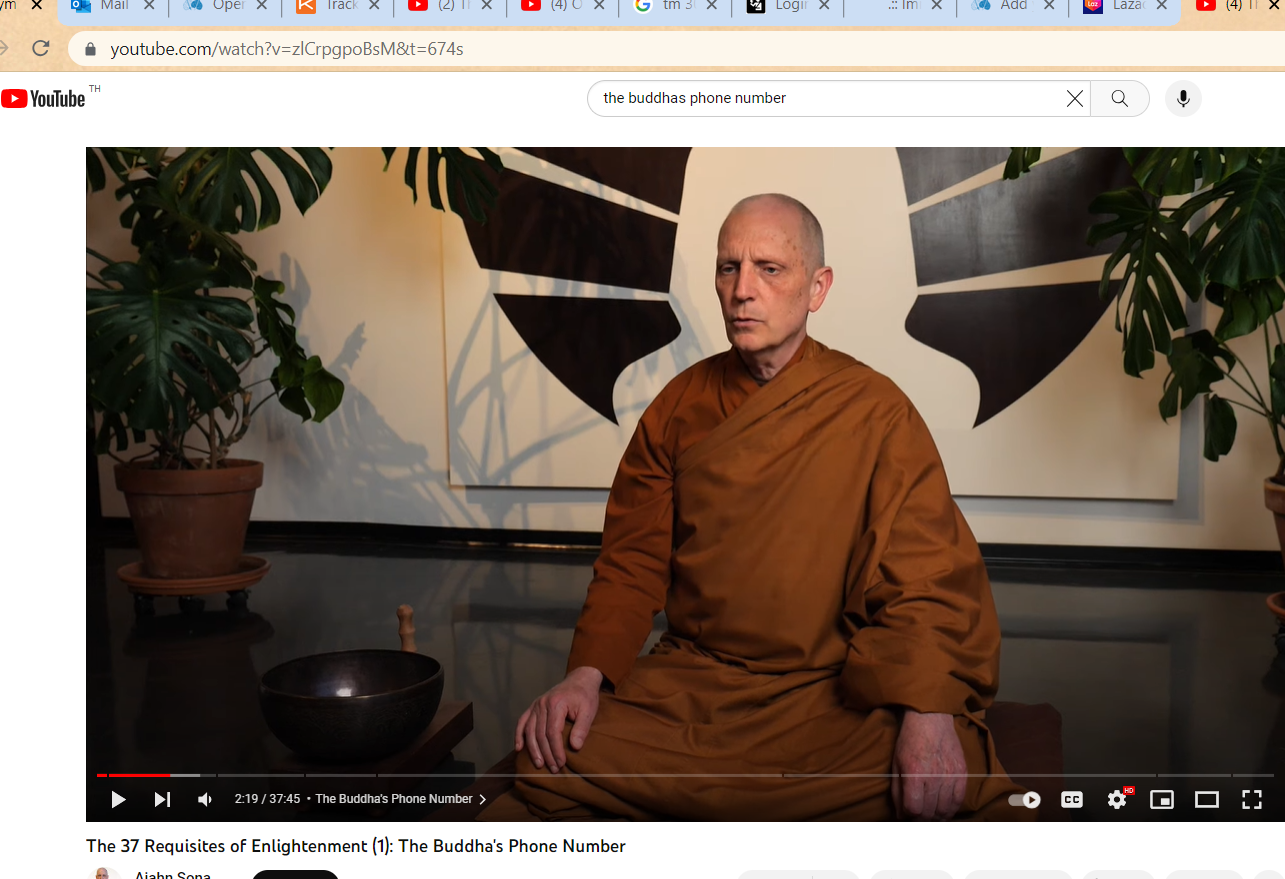
    Screenshot-2023-08-05-133816.png

    The Buddhas phone number .

    https://www.youtube.com/watch?v=zlCrpgpoBsM&t=674s

    875444

    1. 8 fold noble path
      7 factors of enlight
      5 Powers
    2. 5 faculties
    3. 4 foundations of mindfulness
    4. 4 basis of psychic power
    5. 4 right efforts

    Email

    URL

    Views: 37